Agent / LLM App / Full-stack
2026
Role: Agent role design, decision-flow design, risk-control framing, dashboard-oriented product definition
Multi-Agent Quant Research System
A multi-agent research workflow that helps inspect market signals, generate risk-aware suggestions, and review strategy cycles instead of hiding everything behind one trading conclusion.
Impact: Showed how agent decomposition can make financial decision support more transparent by separating market judgment, risk review, portfolio suggestion, and post-cycle reflection into visible steps.

Overview
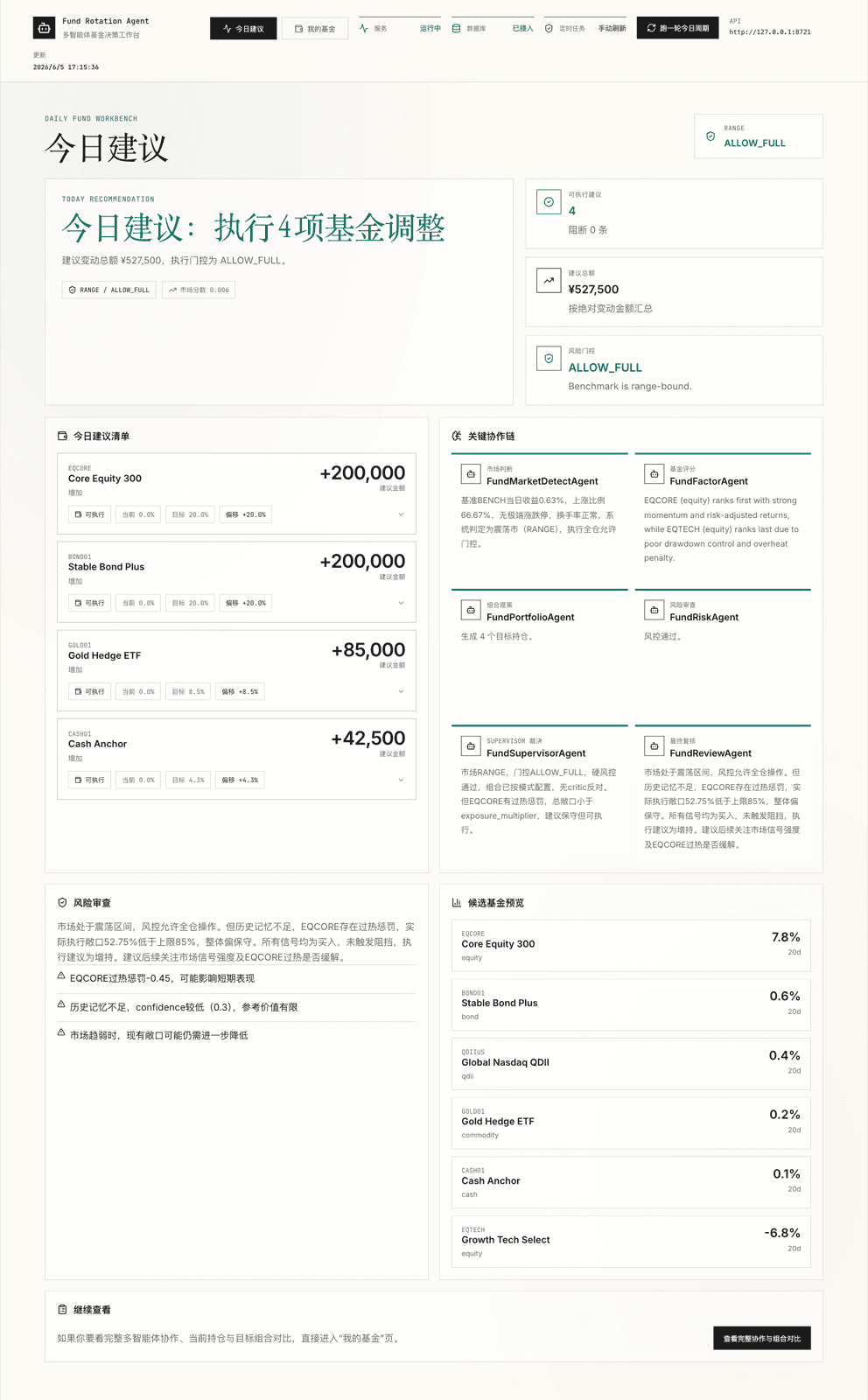
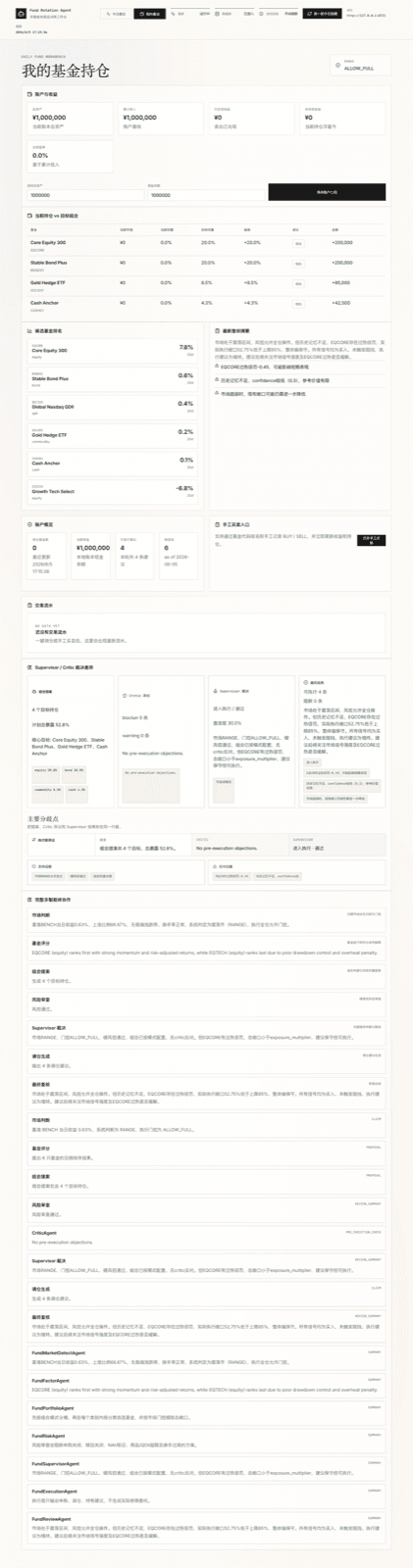
This project reframes quant research as an inspectable decision-support workflow. Instead of asking one LLM for a final answer, I introduced specialized agents for market judgment, critique, review, and next-step suggestion, then surfaced their outputs in a dashboard that can be audited by a human.
Problem
Quant research involves noisy signals, uncertain assumptions, changing market regimes, and risk constraints. If a single LLM directly produces a final conclusion, the system may hide uncertainty, skip risk critique, and make the workflow hard to audit.
Solution
I used LLM agents only where reasoning adds visible product value: signal critique, readable review, and next-step experiment design. Deterministic workflow logic stays separate, which keeps the system cheaper, more controllable, and easier to explain to a non-technical reviewer.
Architecture
A coordinator manages workflow state, routes structured context to specialist agents, collects intermediate outputs, and synthesizes a research memo that highlights signal rationale, risk concerns, disagreements, confidence, and next-step experiments.
Core Features
- Critic agent for pre-execution signal questioning
- Review agent for post-cycle research summaries
- Evolution agent for follow-up strategy experiments
- Structured handoff payloads between workflow stages
- Conflict-preserving synthesis instead of forced consensus
- Human-review-friendly outputs for decision inspection
Tech Stack
- TypeScript
- LLM API
- Agent Orchestration
- Workflow State
Implementation Details
- Separated LLM-connected agents from deterministic workflow components so the system does not depend on LLMs for every step.
- Designed role-specific prompts for critique, review, and evolution instead of using one generic financial analysis prompt.
- Used structured intermediate outputs to make agent reasoning easier to compare, audit, and debug.
- Preserved disagreement and weak-confidence signals in the final memo instead of forcing the system into a clean but fragile answer.
- Framed the system as a research and decision-support tool rather than an automated trading advisor.
Challenges
- Agent workflows can create a false sense of rigor if role contracts and output schemas are not explicit.
- Too many agents increase latency and cost, so each LLM call needs a clear reason to exist.
- Financial research outputs must be framed carefully to support analysis without pretending to provide guaranteed investment advice.
What I Learned
- Agent systems are most useful when they improve process transparency, not when they simply imitate human organization charts.
- For research workflows, preserving disagreement is often more valuable than collapsing everything into one confident answer.
- Good LLM product design requires deciding where not to use the model as much as where to use it.